
Brackets Are a Bad Way to Regulate

Continuous distributions are everywhere - for virtually everything we care about, a little more is a little better (or worse), and a lot more is a lot better (or worse). This presents a problem - we need to create rules that reasonably and fairly apply across these continuums, where the degree to which a thing possesses a trait makes a difference to the reasonable treatment of it.
Going 1m/h over the limit, and going 150 in a 40 zone are both “speeding”, yet we must punish these things differently.
The default solution for almost all regulations is to slice these continuous distributions into chunks, and treat the chunks as basically equivalent phenomena - squishing a continuous distribution into five or so blocks, and manually writing rules to apply uniformly within the blocks.
Examples include:
Speed limits
Tax brackets
Sentencing thresholds
Overtime thresholds
Pension eligibility
This is a very bad system.
Brackets are fundamentally inefficient
For any bracket over a continuous distribution, the upper section of the bracket has more of the trait than the bottom section.
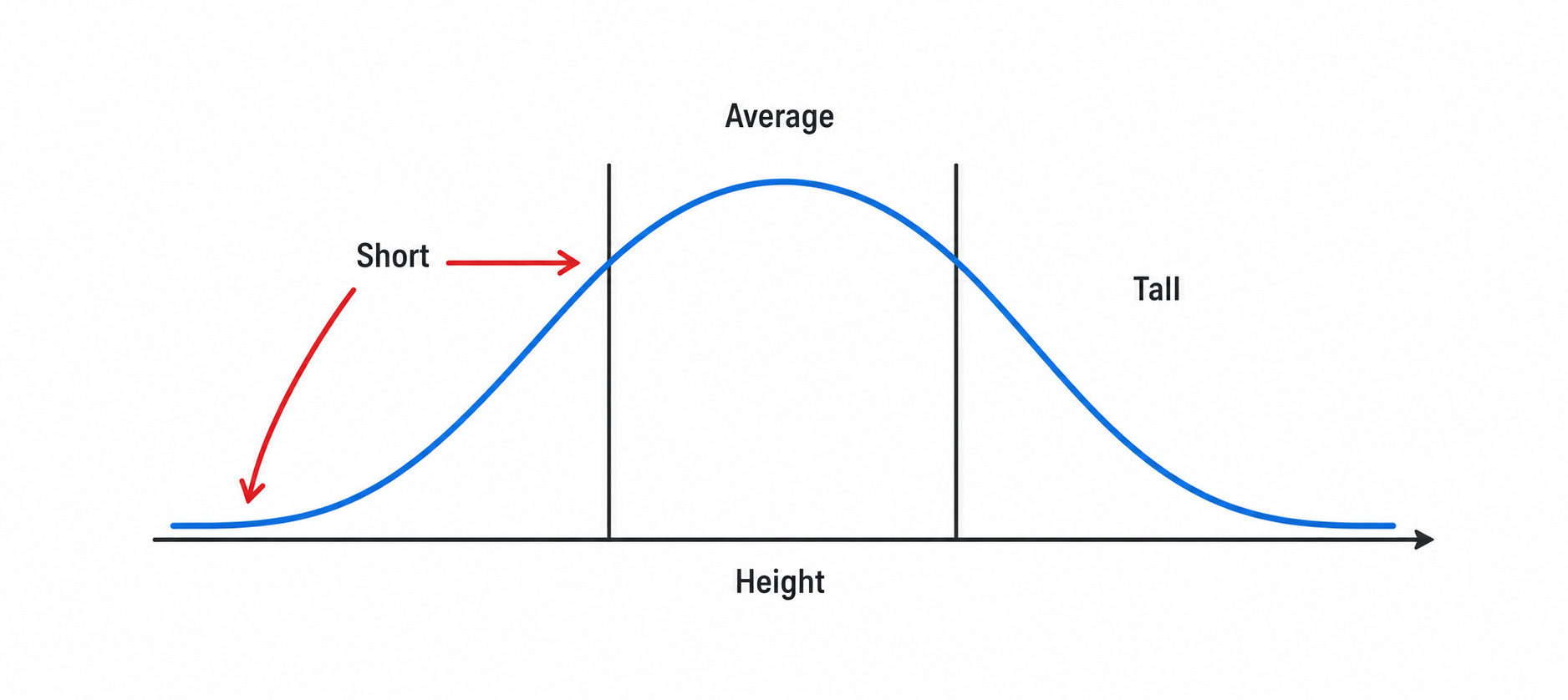
As a result, for any incentive or punishment applying uniformly across a bracket, the ends of the bracket will be disproportionately affected. This introduces inefficiency and incentivises clustering near the edges of the bracket.
Businesses exploit the inefficiency of brackets all the time. Telcos may charge you per minute of usage, such that the second you have called for 1:00:01, you’ve paid for 2 minutes of phone time. More blatantly, hotels will often bill you for an entire extra night if you check out a minute late. Airlines will gleefully charge you double for a bag that’s a gram over the 20kg cutoff. Software subscriptions charge you monthly rather than by the second, and will push you towards even longer, yearly intervals.

Discontinuous thresholds of reward and punishment imposed on continuous distributions almost always incentivise moving to the the top of a given bracket. Once you’re in the bracket, you’re paying the cost of entry, and should rush to the top of the bracket to get your money’s worth.
In 18th century England, there were basically two brackets for criminal justice: perfectly legal, and egregious mortal crime. This forced a choice:
Minor crimes go unpunished
All crimes are punished mildly
All crimes are punished severely
They went for option 3.
At the time, stealing 12 pence (~$40 today) worth of goods, cutting down a tree, and destroying a fish pond were all capital crimes. This incentivised severe escalation. The moment you’ve been caught pickpocketing, you’re going to hang, and you can only hang once. So, the marginal cost of murdering witnesses to your crime was effectively zero. This led not only to escalation of crimes, but also extremely inconsistent enforcement of these penalties. Juries were known to engage in “pious perjury” - lying about the value of goods stolen to avoid the capital threshold, and otherwise excusing behaviour that, by the letter of the law, should have been a killing offense.
The peak of this “bloody code” lasted over a century, from ~1688-1823, before the list of capital offenses was eventually reduced from 225, to 5.
Simplicity trades off against efficiency
The larger the size of the brackets, the greater the inefficiency. This creates a tradeoff - fewer brackets are simpler to understand and administrate, but smaller brackets mean less of a qualitative difference between the top and bottom of each segment.
In practice, virtually all regulations opt for a single-digit number of subdivisions for the entire population.
Given the immense variation present within large populations, there is almost always a relevant qualitative difference within the brackets. A man weighing 230lbs, and a man weighing 630lbs are both in the top quintile of body weight, and are both “obese”1, yet experience vastly different treatment and outcomes.
The obvious solution is to add more brackets to account for these differences. But this means more manual rulesetting, and often requires dozens of brackets to adequately smooth out qualitative differences within groups.
For low variance distributions, a few brackets may do the trick. For high variance distributions, your options are many brackets, or obscenely inefficient incentives.
Formulas completely eliminate bracketing inefficiency
We have possessed the mathematical technology to completely eliminate this gratuitous inefficiency for millenia. Behold: the function.
A function is the ideal treatment of continuous distributions, and can accommodate any shape of reward, punishment, or compensation you desire.
If more X is better than less X, you can either:
Create a few brackets and incentivise the bare minimum to qualify for the bracket
Create many brackets to partially solve the first problem, and invest time manually writing rules for 100 brackets, producing opaque, lengthy regulations.
Express the relationship between X and goodness as a function, and solve both problems completely.
For example, US federal drug trafficking laws impose the following mandatory minimums for cocaine possession:
Under 500g — no mandatory minimum, judge has discretion
500g to 4,999g — mandatory 5 years, maximum 40
5kg+ — mandatory 10 years, maximum life
Crossing these arbitrary thresholds by trivial amounts produces a massive, discontinuous change in mandatory punishment. Once you’re past a threshold, massive increases within the threshold produce negligible differences. Under this system, a trafficker has no marginal incentive, once they’ve got 500g of inventory, to avoid adding an extra 4.499kg to their stock2.
With a formula, you can still hand out 10-year mandatory minimums to 5kg traffickers, and 5-year minimums to 0.5kg traffickers, while disincentivising additional possession between those ranges.
For example: Mandatory minimum sentence = 0.80 * (grams-500)^0.30 gives us a very reasonable looking prescription for every stage3.
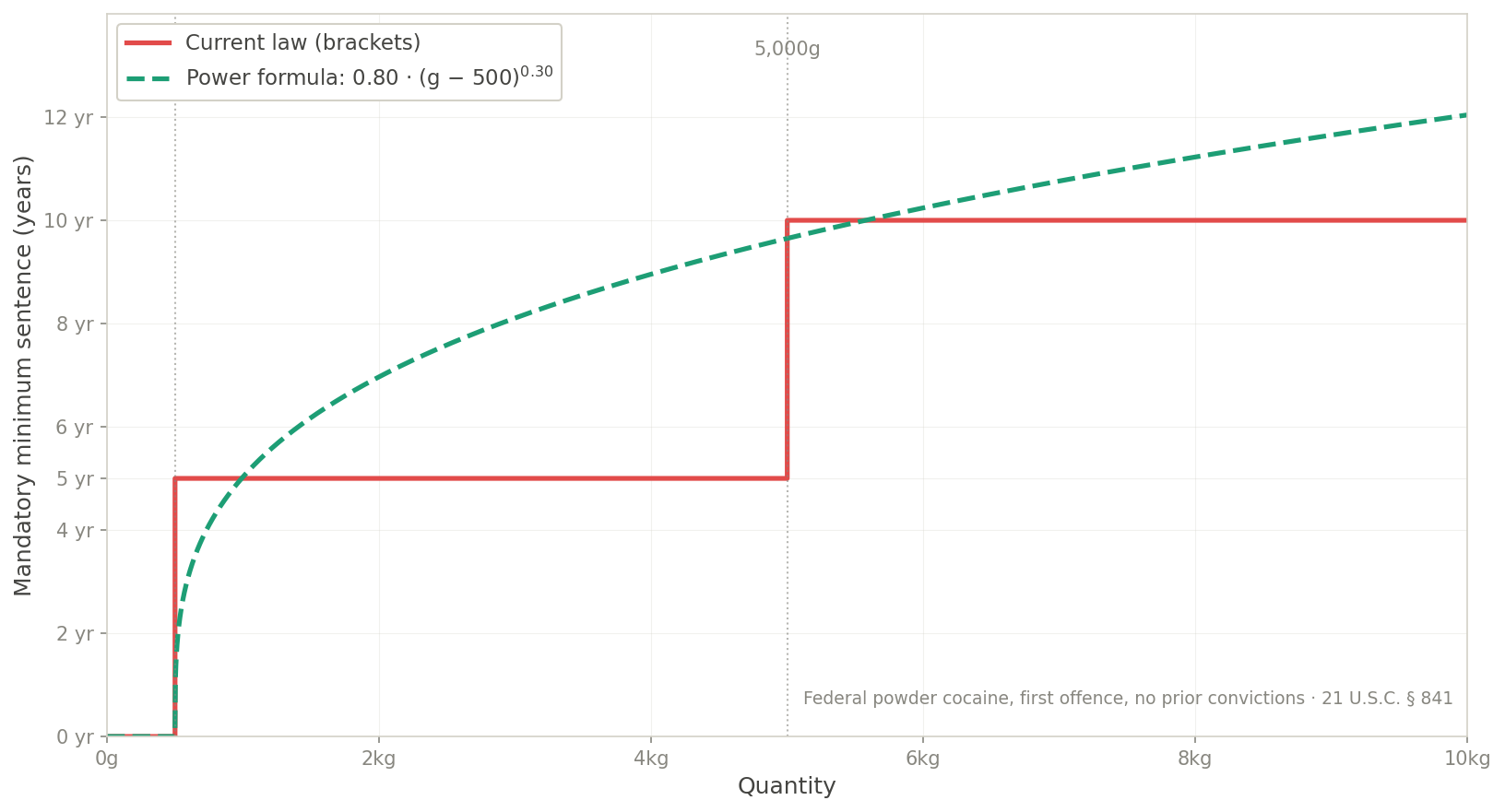
With this system, there is no amount of contraband you can possess for which additional contraband goes unpunished.
And, because these are minimums rather than exact prescriptions, this preserves the ability for judiciary discretion in exactly the same way brackets do.
What about administrative convenience?
Administrative convenience is valuable, and most regulations are a pragmatic compromise between efficacy and usability. This may produce concerns like:
People won’t remember the formulas
Nobody remembers the brackets either, and you can publish bracketed tables that show example values just like they do now, with intervals as large or small as you like. For example, the (rounded) trafficking formula outputs represented as a table is as follows:
1kg: 5.2yr
2kg: 7.2yr
3kg: 8.4yr
4kg: 9.3yr
5kg: 10 yr
Formulas are opaque and difficult to use
No, they aren’t. Published formulas and their outputs can be verified by anyone. Online calculators are featured on many commercial and government websites and are trivial to use.
Current widely used brackets are already opaque. For instance, in California, speeding fines are calculated based on brackets: 1–15 mph over costs $35 as a baseline, but this is modified by as many as 15 separate legislative surcharges which multiply that figure by up to 7×, varying by county, producing a final bill that is virtually impossible to exactly predict in advance.
Additionally, many brackets are framed as “over this limit, X applies”, but X is often modified by “whatever the judge deems reasonable”, which is fundamentally more unpredictable, opaque, and administratively costly than a standard formula.
Formula-based systems are already used without catastrophic admin and communication issues. Child support calculations in 41 US states use an income share formula where both parents’ incomes, the custody split, and number of children feed into a continuous dollar output. FICO credit scores compress dozens of variables into a single output, and there is broad agreement among economists that this produces more consistent lending decisions. Student loan repayments are calculated formulaically as well.
Defending bracket-based systems on the basis of administrative simplicity and public interpretability therefore relies on the often false premise that bracket-based systems are simple and interpretable, and that formulaic ones are not.
__
As long as “more is worse”, “a little more is a little worse”, and “a lot more is a lot worse”, brackets are the wrong tool for the job. We should make the world a bit saner and start using more formulas.
At average height
This is modified by the discretion of a judge, who will often tack on extra sentences in proportion to the amount of drugs you have - acting much like a function
Assuming you find the original paradigm reasonable, a separate question.